Why does time flow? One unusual answer, from the physicist Richard Muller and his co-author Shaun Maguire, is that the universe keeps making new time, the same way it makes new space as it expands. The "now" would be the edge where new time is being added.
That sounds untestable, but they pointed at a place where it could show up. When two black holes merge, a lot of new space appears at once. If new time comes with it, the gravitational wave from the end of the merger should reach us a little late compared with what Einstein's equations predict.
We took that idea and tested a version of it on real data.
The version we tested
Muller and Maguire tie the new time to a volume of space. The trouble is that a volume depends on how you slice spacetime into space and time, so their version needs one preferred way to slice it, and experiments give very little room for that.
So we tied the new time to something every observer agrees on: the area of the black holes' horizons. When two black holes merge, the final horizon is larger than the two original ones put together. We let the delay grow with that extra area:
delay = β × √(added horizon area / 4π) / c
Here β is a single free number. If the idea is right in its simplest form, β is about 1. If there is no such effect, β is 0.
For GW250114, one of the loudest black-hole mergers recorded so far, β = 1 means a delay of about 0.36 milliseconds, switched on in the last few milliseconds as the horizons join:
The moment when the horizons join is not something we chose. We read it from public computer simulations of merging black holes (the SXS catalogue), where the common horizon appears about 7–8 units of the system's mass before the peak of the wave.
How we looked for it
We downloaded the LIGO data of GW250114 from the Gravitational Wave Open Science Center and fitted it with two models at once: the standard waveform, and the same waveform with the delay switched on at the horizon moment. The fit gives a range of delays that agree with the data.
Before trusting the answer on real data, we checked the method in two ways:
- We added a fake signal without any delay into real detector noise near the event. The analysis correctly returned "no delay".
- We added a fake signal with the β = 1 delay. The analysis found it, and none of its solutions were consistent with zero delay.
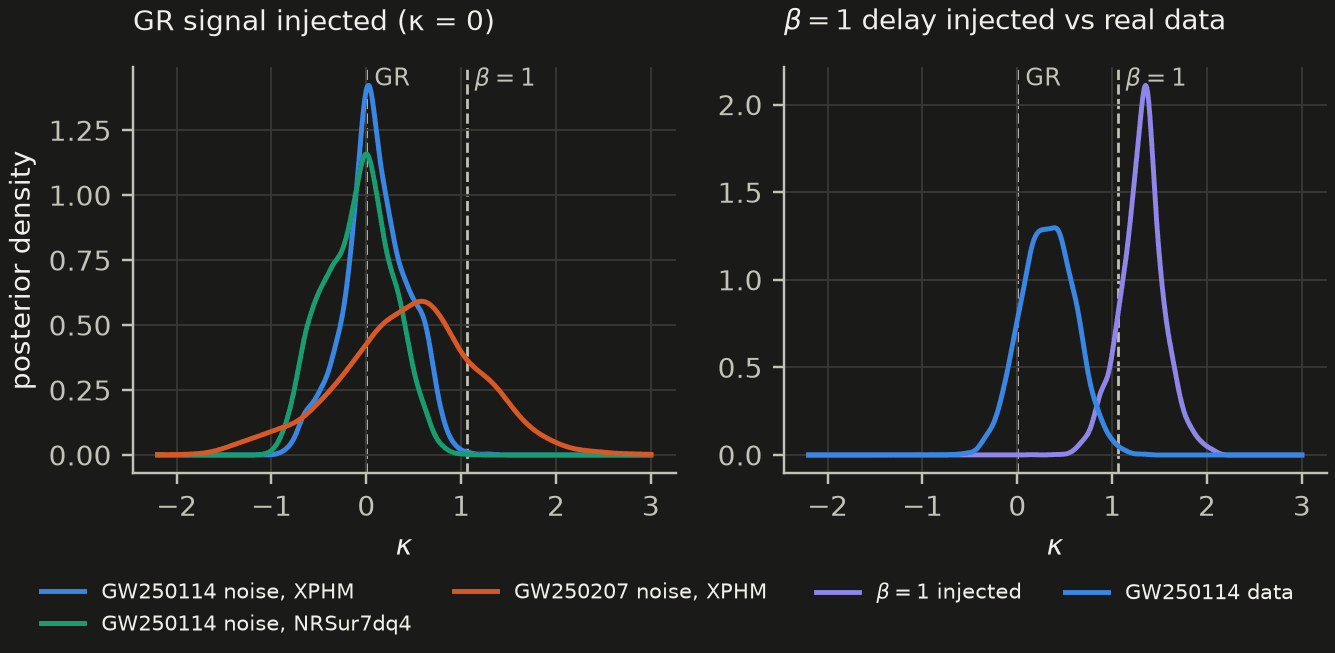
The right panel is the key one. A β = 1 delay (purple) would have been easy to see. The real data (blue) sit well to the left of it.
What the data say
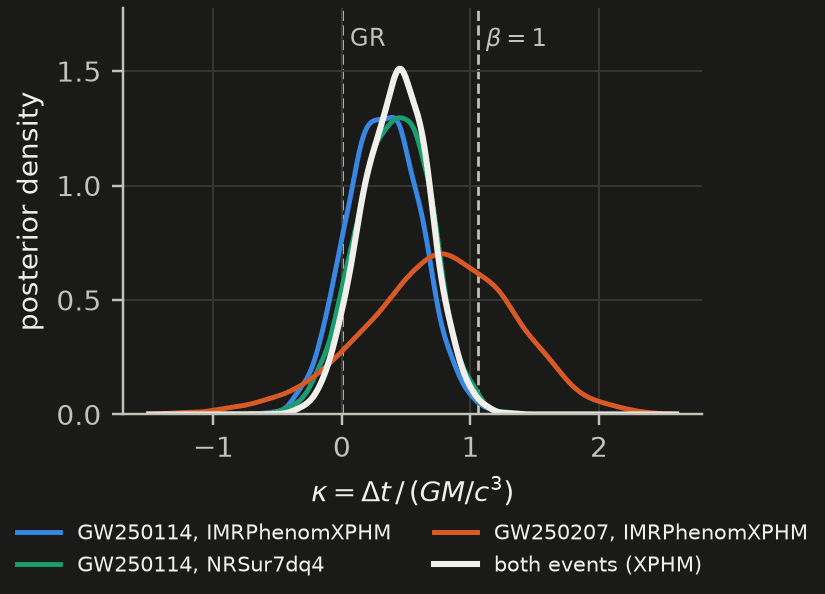
With two independent waveform models, the data of GW250114 give:
- β < 0.74 (first model) and β < 0.79 (second model), at 95% confidence;
- β = 1 is disfavoured at about 2.6σ in both;
- a variant where the delay has a random sign and a bigger size is ruled out.
We added a second merger, GW250207. Only two of the three detectors are usable for it here, so it is much less sharp, and on its own it cannot tell β = 0 from β = 1. Combined with GW250114, the bound stays at β < 0.79.
What this does not show
This is a limit on one specific idea. It is not evidence for it, and it is not a claim about time in general. Some honest caveats:
- One loud event carries almost all the weight. 2.6σ is suggestive, not decisive.
- The 2.6σ counts only statistical noise. The two waveform models already differ a little; a modelling error a few times larger than that difference would bring β = 1 to about 1.6σ.
- The shape of the delay's switch-on is a simple smooth step; real horizon growth is a jump followed by slower growth.
- We used a generic model for detector calibration, not the collaborations' own.
- The tests of the method used one stretch of noise each.
Eleven more loud mergers in the open catalogue pass the same cuts. The analysis of the three loudest of them is running now. If the idea is wrong, the limit should tighten; if β = 1 were true, the events should start pulling towards it.
The full write-up, with tables, every check and references, is here as a PDF: Does a black-hole merger create time? A bound from GW250114.
Data: Gravitational Wave Open Science Center (gwosc.org), LIGO, Virgo and KAGRA. Simulations: SXS catalogue. Analysis: bilby and dynesty.